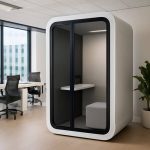
Open-plan offices were meant to spark collaboration, but they often create a different reality: constant noise, visual distractions, and a shortage of quiet places to hold a focused conversation. A Conference Pod solves that problem by placing a fully enclosed, acoustically engineered meeting room right inside the floorplate. It gives teams a professional space for video calls, interviews, project huddles, and client presentations without forcing them to book a traditional meeting room or retreat to a noisy café.
What Is a Conference Pod and Why Does It Matter in Modern Workplaces?
A Conference Pod is a self-contained, modular meeting space designed for two to six people or more, depending on the configuration. Unlike a single-person phone booth, it includes a table, seating, and enough interior volume for real discussion. It is not just a glass box with a door. It is a controlled environment where speech stays inside, outside noise stays out, and the technology needed for hybrid collaboration is already integrated. In a hybrid workplace, where some teammates are in the room and others join remotely, that combination of acoustic privacy and ready-to-use conferencing tools is essential.
The demand for these spaces has grown because open-plan offices have a math problem. A 200-person floor might have only six formal meeting rooms. Those rooms are booked solid, yet employees still need to take sales calls, conduct one-to-ones, review designs, or interview candidates. When no private space is available, people take calls at their desks, lower their voices, and unintentionally distract everyone around them. A Conference Pod restores choice. It lets organizations add meeting capacity without construction, lease expansion, or a disruptive renovation.
The business case goes beyond convenience. Noise is a productivity tax. Studies on workplace performance repeatedly show that distraction harms concentration, increases stress, and slows task completion. A pod reduces that tax by creating a quiet zone for focused work and confidential conversations. It also improves the professional image of video meetings. Instead of a caller seeing a blurry open office or hearing background chatter, they see a clean, well-lit interior with predictable acoustics. For sales teams, recruiters, consultants, and executives, that difference can protect credibility and close deals.
Flexibility is another advantage. A well-designed Conference Pod can be installed in hours rather than weeks, and it can be relocated when the layout changes. That matters for fast-growing companies, coworking operators, and organizations testing new ways of working. Instead of committing to fixed drywall, they can deploy pods as demand shifts from one department, floor, or building to another.
Core Design Features That Separate a Good Conference Pod from a Mere Enclosure
Not every glass room qualifies as a high-performance Conference Pod. The difference lies in the engineering detail. Acoustic performance begins with the wall structure. Quality pods use layered materials, acoustic infill, and dense panels to block airborne sound. Interior surfaces are often finished with PET acoustic panels that absorb reflections, reducing echo during calls. Glass is typically double-layer or laminated to improve sound insulation while maintaining visual openness. Sealed doors and carefully designed gaskets close the final gaps where noise would otherwise leak. Without these elements, a pod may look private but still transmit every word to the surrounding office.
Ventilation is equally important. A sealed room with poor airflow becomes uncomfortable within minutes, which defeats the purpose of a usable meeting space. Effective pods use low-noise ventilation systems that exchange air without creating a distracting hum. Some models include occupancy sensors, adjustable lighting, and temperature controls so users can set the environment for a short stand-up or a longer workshop. Comfort may seem secondary to acoustics, but it directly affects how often people choose the pod. If a space feels stuffy or dim, employees will avoid it.
Technology integration is another defining feature. A modern Conference Pod should be ready for Microsoft Teams, Zoom, and Google Meet from the moment someone steps inside. That means integrated power outlets, USB charging, reliable network connectivity, and often a display mount or wireless presentation capability. Cabling should be managed and concealed, not left as an afterthought. The goal is a plug-and-play experience: open the door, join the call, and start speaking. When technology is built in, meeting setup time drops and the pod becomes a genuine extension of the company’s digital workplace.
Customization and modularity also matter. Organizations may need a two-person focus room, a four-person huddle pod, or a larger conference pod for team reviews. They may want glass, solid panels, branded finishes, or specific furniture. A modular system allows those choices without treating each pod as a one-off construction project. Look for adjustable sizes, material options, and the ability to relocate the unit later. Accessibility, electrical planning, and fire safety should also be reviewed during specification. The best pods are not just quiet boxes; they are safe, comfortable, code-aware workspaces that support daily use.
Real-World Scenarios: Where Conference Pods Deliver the Highest ROI
In a corporate headquarters, Conference Pods work best as a supplement to formal meeting rooms. Place them near team neighborhoods where ad hoc collaboration happens. A product team can use a four-person pod for sprint planning, while a sales director uses a larger pod for a client presentation. Recruiting can conduct interviews without walking candidates through a noisy floor. Finance can hold confidential reviews without booking the boardroom. For hybrid teams, pods also create equity: remote participants get a clear audio experience, and in-room participants get a dedicated space designed for cameras and microphones.
Coworking spaces and flexible office operators see a direct revenue opportunity. Meeting rooms are a premium amenity, but building more of them is expensive. Conference Pods add bookable capacity at a fraction of the cost and can be branded to match the location. Members who might otherwise take calls in common areas can reserve a pod for an hour, improving satisfaction and reducing noise complaints. Operators can also use pods to differentiate their offering: a startup suite with access to on-demand conference pods is more attractive than a bare desk in a loud room.
Education and healthcare settings have similarly strong use cases. Universities can place pods in libraries, student unions, and innovation hubs for group projects, thesis defenses, and remote interviews. Healthcare clinics can use them for telehealth appointments, private consultations, or quiet documentation. Airports and hotels can offer business travelers a soundproof place to join a meeting between flights or before an event. In each case, the pod solves a specific privacy problem without requiring permanent construction. The common thread is a need for acoustic separation, quick access, and professional presentation.
To maximize return on investment, plan pods around user journeys rather than empty corners. Map where people already take calls and where noise complaints cluster. Check power, data, lighting, and foot traffic. Decide whether pods will be first-come, first-served or bookable through a calendar system. Consider acoustic zoning so quiet pods are not placed next to loud printers or kitchenettes. In dense city centers where square footage is expensive, a Conference Pod can turn underused space into high-value meeting capacity. In growing campuses, it can be deployed in phases as teams expand.